
North Corfu · Villages & History
Old Perithia, Corfu: A Complete Guide to the Island's Oldest Village
History, what to see, where to eat, how to get there and the hike to Mount Pantokrator.
Old Perithia (Palea Perithia, Greek: Παλαιά Περίθεια) is a stone village hidden in a high valley on the northern flank of Mount Pantokrator, in the northeast of Corfu. It is widely described as the oldest surviving village on the island, it was declared a protected monument in 1996, and for most of the past sixty years it stood almost empty.
Today it is one of the most rewarding half-day trips in North Corfu: car-free lanes lined with Venetian-era mansions, roofless houses reclaimed by fig trees, eight churches and a few family tavernas around the old square. This guide explains why the village was built where it is, why it emptied, what is worth seeing and how to plan a visit that goes beyond a quick lunch.
Old Perithia at a Glance
| Fact | Details |
|---|---|
| Official name | Palea Perithia (Old Perithia), Παλαιά Περίθεια |
| Location | Northeast Corfu, on the northern slopes of Mount Pantokrator, inland from Kassiopi |
| Altitude | About 450 m, in an upland valley below the 906 m summit of Pantokrator |
| First written records | 14th century (settlement believed to be older) |
| Population at its peak | Up to about 1,200 people |
| Buildings | Around 130 stone houses and 8 churches |
| Protected status | Declared a monument in 1996 |
| Abandoned | Gradually, ending in the 1960s |
| Permanent residents today | 6 (2021 census) |
| Car access | Parking on the edge of the village; the centre is pedestrian only |
Where Old Perithia Is and Why It Was Built There
The village sits at roughly 450 metres, inside a fertile basin that cannot be seen from the sea. That invisibility was the whole point. For centuries the Ionian coast was exposed to pirate raids, and a settlement tucked behind a ridge, reachable only by a steep track, was far harder to find and far easier to defend.
The second reason was health. Corfu’s coastal lowlands were malarial until the 20th century, while the cooler upland air kept the mosquitoes away. The trade-off was farming: the valley supported livestock and some crops, but most arable land lay lower down near the coast. That tension between a safe home in the hills and a living earned by the sea shaped the whole history of Perithia.
A Short History: From Wealthy Village to Ghost Village
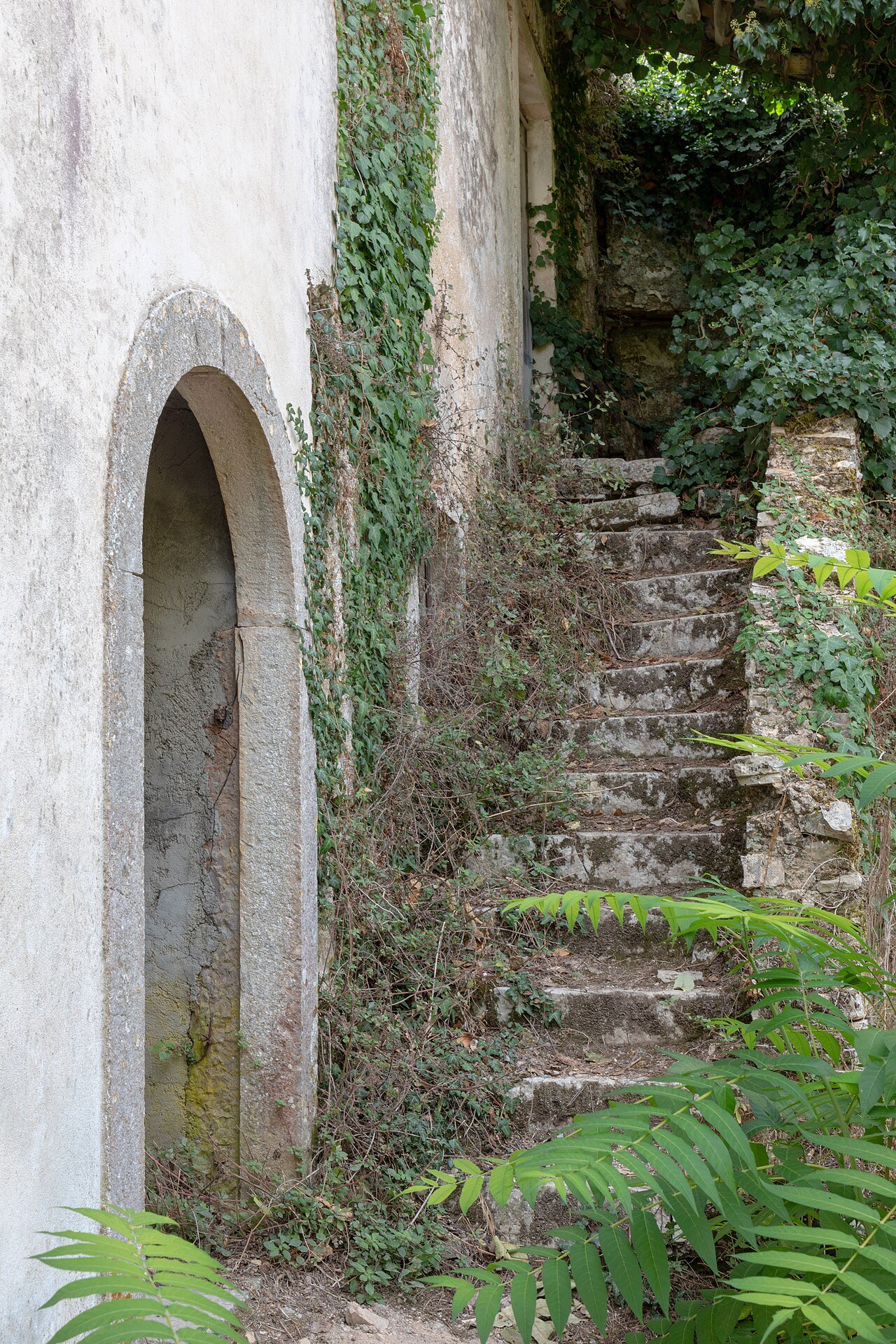
Written records begin in the 14th century, although the site was almost certainly inhabited earlier. At its height Perithia was one of the wealthiest communities on Corfu, with up to 1,200 inhabitants, around 130 houses and eight churches. You can read that prosperity in the buildings: two-storey mansions with thick limestone walls, external stone staircases and arched doorways were built by families who traded in olive oil, livestock and goods passing through the northeast of the island.
The decline was slow and logical. By the 19th century piracy had faded, so many families began wintering by the sea and returning to the mountain only for the malaria-prone summer months. In the 20th century malaria was eradicated, and tourism created jobs in Kassiopi, Acharavi and the other coastal resorts. One by one the households moved down, and by the 1960s the village was effectively abandoned. The irony, often repeated by the people who now live and work there, is that tourism emptied Old Perithia and tourism is now bringing it back.
The Revival of Old Perithia
The revival started around 2009 and 2010, when a London publisher and his Dutch partner restored a group of ruined houses and began promoting the village. Descendants of the original families followed, reopening tavernas and repairing their own properties. A 17th-century merchant’s mansion near the entrance is now The Merchant’s House, a small guesthouse with five suites, and the 14th-century church of Agios Iakovos o Persis was professionally restored in 2013 and 2014.
The protected status cuts both ways. It is the reason Old Perithia has not been filled with concrete villas and souvenir shops, and it is also the reason restoration is slow and expensive: any work has to respect the original materials and layout. The result is a village that feels genuinely old, with ruins and restored houses side by side, rather than a polished open-air museum.
What to See in Old Perithia
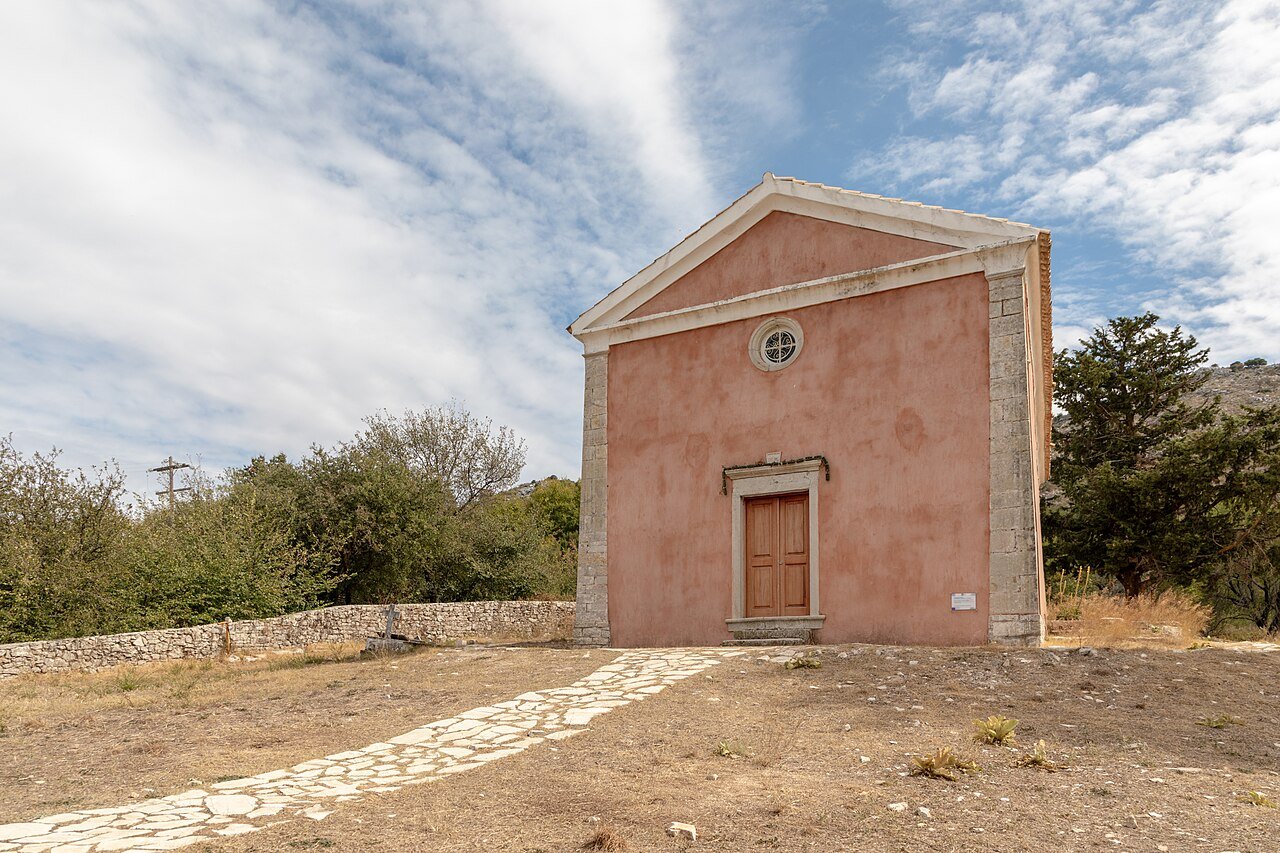
- Agios Iakovos o Persis. The first church you meet at the village entrance, built in the 14th century and known for its frescoes. It is the most important monument in Old Perithia.
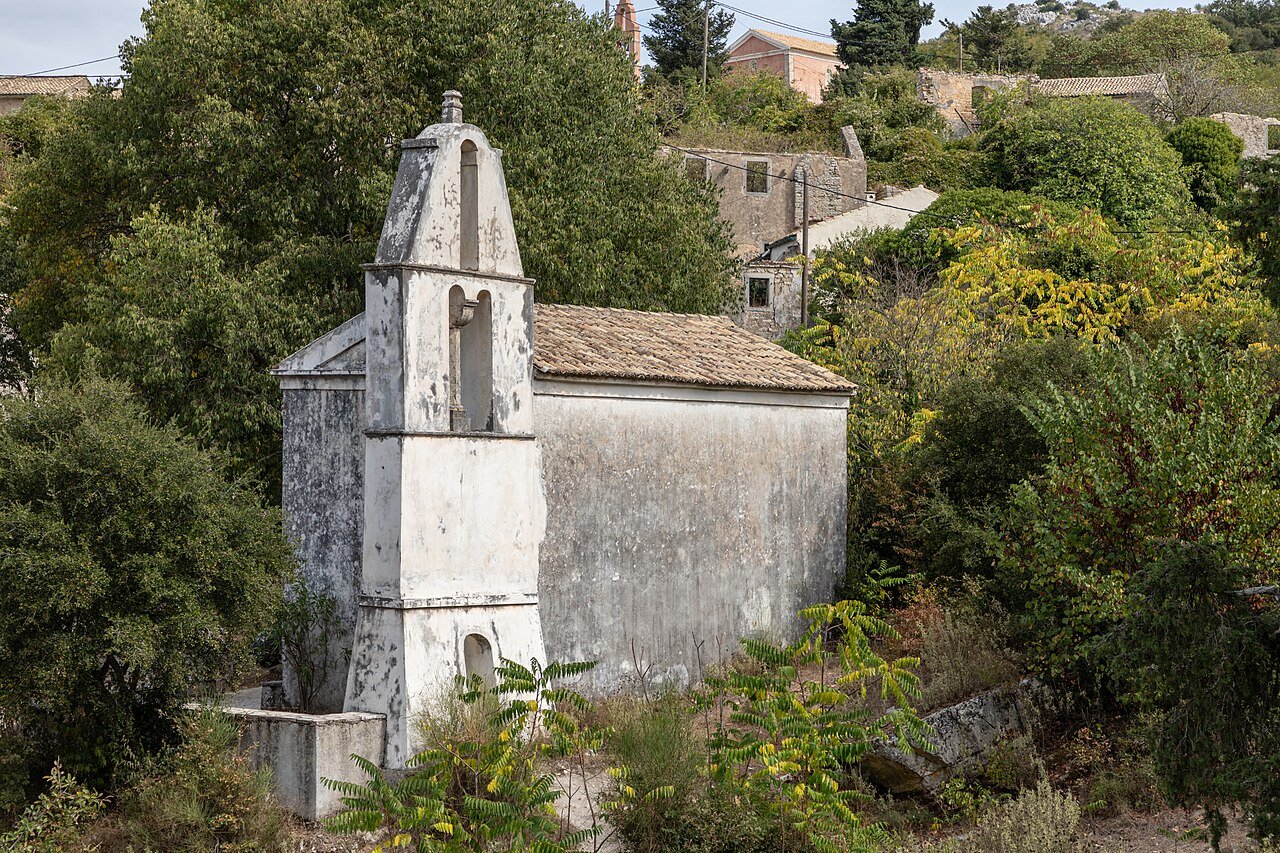
- Agios Spyridon. The main village church near the square, with a tall bell tower that makes a natural landmark when you walk the lanes.
- The old school. Its front steps give one of the best views over the rooftops (and the missing roofs) of the village.
- The mansions and lanes. Walk slowly and look for carved doorframes, outdoor stone staircases, old ovens and cisterns. Many houses are ruins, so admire them from the lane.
- The viewpoint above the village. A short climb on the path towards Pantokrator gives a full view of the valley, with olive groves and kumquat trees framing the houses.
- The square (foros). In Corfu the village square is called the foros, which is also why one of the tavernas carries the name.
Where to Eat in Old Perithia
Lunch in the square is part of the experience. Several family tavernas operate around the foros, serving Corfiot home cooking in shaded courtyards. The Old Perithia taverna is run by a family whose history in the village goes back to the 19th century and is known for homemade ginger beer (tsitsibira), a drink Corfu inherited from the British period. O Foros, run by Thomas and Vasso, is praised for slow-cooked dishes such as pastitsada, lamb and rabbit stew, and Taverna Evdokia occupies the premises of the former Capricorn.
Look out for pastitsada, sofrito, local cheeses, wild greens and walnut pie with Corfiot honey. Opening hours are seasonal and some places close in winter, so check before you travel outside the main season.
How to Get to Old Perithia
Most visitors drive. From the coast road, head to Kassiopi and follow the signs inland through Loutses. The final kilometres are narrow and winding, so take it slowly, especially in a large rental car. The village centre is car-free: leave the car in the parking area on the outskirts and walk in.
There is also a Green Bus (KTEL) service from Corfu Town via Kassiopi, although departures are limited, so check the current timetable. Walkers can arrive on foot: the long-distance Corfu Trail passes through Old Perithia, and the village is the classic starting point for climbing Mount Pantokrator.
| Route | Approx. distance | Approx. time | Notes |
|---|---|---|---|
| Car from Corfu Town via Kassiopi | About 45 to 50 km | About 1 h 15 min | Last section is a narrow mountain road with hairpin bends |
| Car from Kassiopi via Loutses | About 8 to 14 km, depending on route | 20 to 30 min | Signposted; park on the village edge and walk 3 to 5 min |
| Green Bus from Corfu Town | Via Kassiopi and Loutses | About 1 h 40 min | Limited departures; 10 to 15 min walk from the drop-off |
| Hiking loop to Pantokrator summit | About 10.5 km, 460 m ascent | 3 to 3.5 h | Moderate; take water, little shade near the top |
Best Time to Visit and Practical Tips
Spring (April to June) and autumn (September and October) are the best months. Temperatures are comfortable for walking, the valley is green and the light on the stone is beautiful. In July and August the middle of the day is busy with day-trippers and coach groups, but most leave by late afternoon, and an evening meal in an almost empty village is a completely different experience. In winter it is atmospheric but very quiet, and several tavernas may be closed.
- Wear proper shoes. The lanes are cobbled, uneven and slippery after rain.
- Do not enter ruined houses. Many structures are unstable, and most ruins are still private property.
- Carry some cash for coffee and small purchases, even though larger tavernas usually take cards.
- Allow 2 to 3 hours for a walk and lunch, or a full day if you add the Pantokrator hike.
- Combine the visit with Kassiopi, the beaches of the northeast or the drive up to Pantokrator.
Is Old Perithia Worth Visiting?
It depends on what you expect. Some visitors arrive imagining a lively, fully inhabited village and leave disappointed: much of Old Perithia is still ruins, and there are no shops or sights in the conventional sense. If you value atmosphere, history, slow food and walking, it is one of the most memorable places on Corfu. Analytically, its appeal rests on three things that are rare on a busy island: a complete medieval settlement pattern, almost no modern construction, and no cars. That combination is exactly what the 1996 protection was meant to preserve.
Old Perithia FAQ
Why was Old Perithia abandoned?
The village was built in the hills for protection from pirates and coastal malaria. Once piracy ended and malaria was eradicated, families moved to the coast, where tourism offered work. By the 1960s the village was effectively empty.
Is Old Perithia the oldest village in Corfu?
It is widely considered the oldest surviving village on the island. Written records go back to the 14th century, and the settlement is believed to be older.
How many people live in Old Perithia today?
Very few. The 2021 census recorded 6 permanent residents, although more people work there in season at the tavernas and guesthouses.
Can you drive into Old Perithia?
You can drive to the village but not through it. There is parking on the outskirts, and the centre is a short walk away on foot.
How long should I spend in Old Perithia?
Two to three hours is enough to walk the lanes, see the churches and have lunch. Plan a full day if you also want to hike to Mount Pantokrator.
Can you hike from Old Perithia to Mount Pantokrator?
Yes. A popular loop of about 10.5 km with roughly 460 m of ascent takes around 3 to 3.5 hours. Take water, sun protection and a map or GPS track.
Is there a bus to Old Perithia?
Yes, a Green Bus (KTEL) route runs from Corfu Town via Kassiopi and Loutses, taking about 1 h 40 min. Departures are limited, so check the timetable before you go.
Can you stay overnight in Old Perithia?
Yes. The Merchant’s House, a restored 17th-century mansion with five suites, is the best-known option, and a few restored houses are also rented to visitors.
Are the tavernas open all year?
Most operate seasonally, roughly from spring to autumn, and opening hours can change. Outside the main season it is wise to call ahead.
Sources: Wikipedia (Perithia), old-perithia.com, Greek and international travel press. Photos by Dietmar Rabich via Wikimedia Commons, licensed CC BY-SA 4.0. Taverna names and opening times change; confirm locally before your visit.