
West Corfu · Villages & Beaches
Pelekas, Corfu: Village Guide, Kaiser's Throne and Nearby Beaches
History, the famous sunset viewpoint, the best beaches below the village and how to get there.
Pelekas (Greek: Πέλεκας) is a hilltop village on the west side of central Corfu, about 13 km from Corfu Town. It is best known for the Kaiser’s Throne, the rocky lookout above the village where Kaiser Wilhelm II came to watch the sun set over the Ionian Sea. Below it lie some of the finest beaches on the island, including Kontogialos, Glyfada and Myrtiotissa.
What makes Pelekas interesting is that it is two places at once: a traditional inland village with documented roots going back to at least the 16th century, and a gateway to one of the busiest beach coasts in Corfu. This guide looks at both sides: its history, the Kaiser connection, the beaches, how to get there and how to plan a visit that is more than a sunset photo.
Pelekas at a Glance
| Fact | Details |
|---|---|
| Name | Pelekas (Πέλεκας) |
| Location | West central Corfu, on a hilltop above the Ionian coast |
| Distance from Corfu Town | About 13 km, roughly 25 to 30 minutes by car |
| Administration | Municipal unit of Parelioi, Municipality of Central Corfu and Diapontia Islands |
| First records | Named in Corfu archives from the 16th century |
| Population (2021 census) | 373 in the village, 647 in the wider community |
| Best known for | Kaiser’s Throne sunset viewpoint |
| Nearest beach | Kontogialos (Pelekas Beach), just below the village |
| Public transport | Blue Bus No. 11 from San Rocco Square, Corfu Town |
A Short History of Pelekas
Nobody knows exactly when Pelekas was founded. The name appears in Corfu’s archives from the 16th century and in church records from the 17th. One theory links it to pelekis, an old axe used by villagers to cut wood and dress stone, which fits a community that lived from olive groves and building.
Venetian-era surveys give a clear picture of village life. In 1759 Pelekas had 51 families and 283 residents, around 4,700 olive trees and four olive oil presses. By 1770 the number of olive trees had roughly doubled, and by 1879 the population had reached 685. Six churches were already standing by 1755, among them Theotokos Odigitria, Agios Nikolaos and Agios Onoufrios, and they still define the skyline today.
After the British returned the Ionian Islands to Greece in 1864, Pelekas became part of the Municipality of Parelioi, and in 1912 it gained its own mayor as an independent municipality. Today it is again part of a larger municipality, and like many Corfiot villages it has been losing permanent residents: from 637 people in 1981 to 373 in 2021. The difference is that Pelekas did not empty out. Tourism moved into the village rather than pulling people away from it.
The Kaiser's Throne: Corfu's Most Famous Sunset
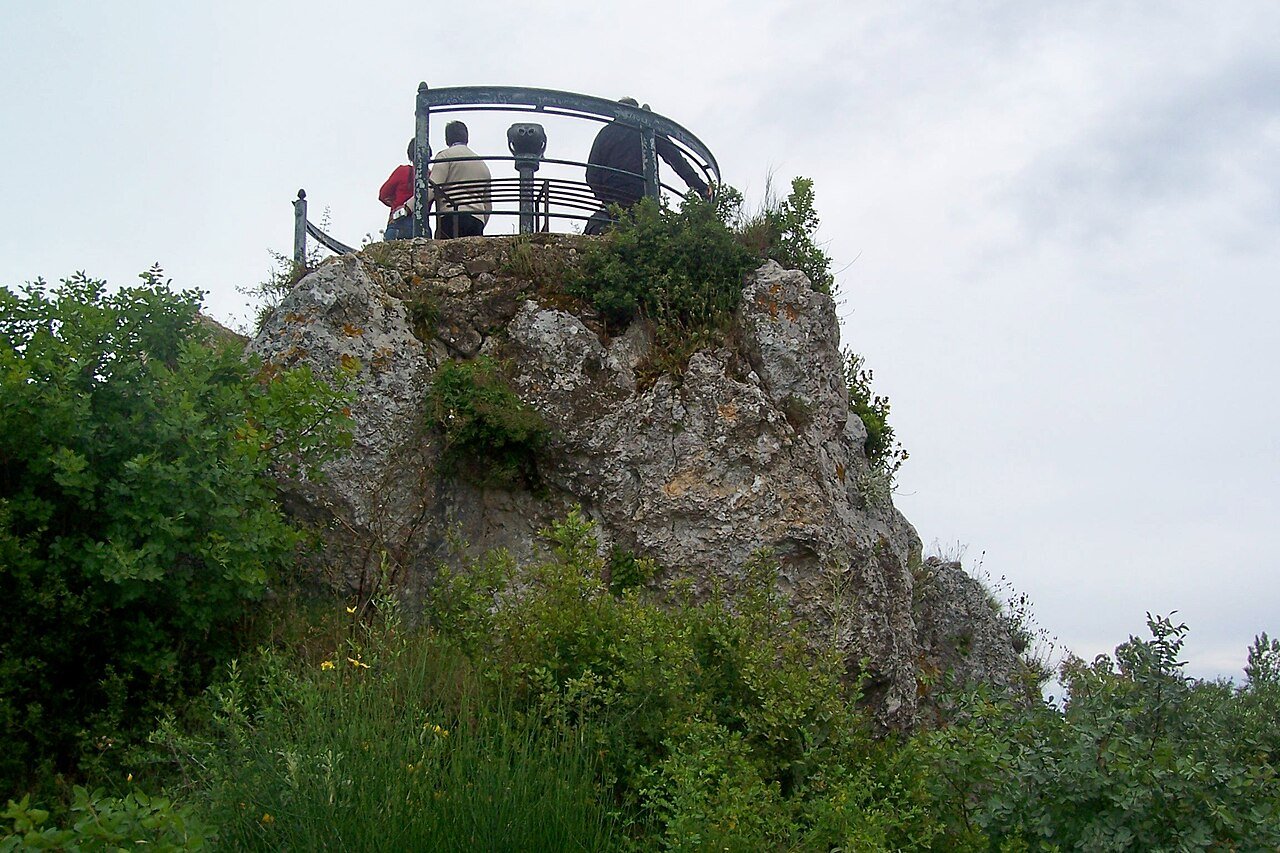
The village’s fame is tied to one man. Kaiser Wilhelm II bought the Achilleion Palace at Gastouri in 1907 and spent his summers on Corfu until the First World War. His favourite outing was the trip to Pelekas to watch the sunset, and the rock platform at the top of the village has been called the Kaiser’s Throne ever since.
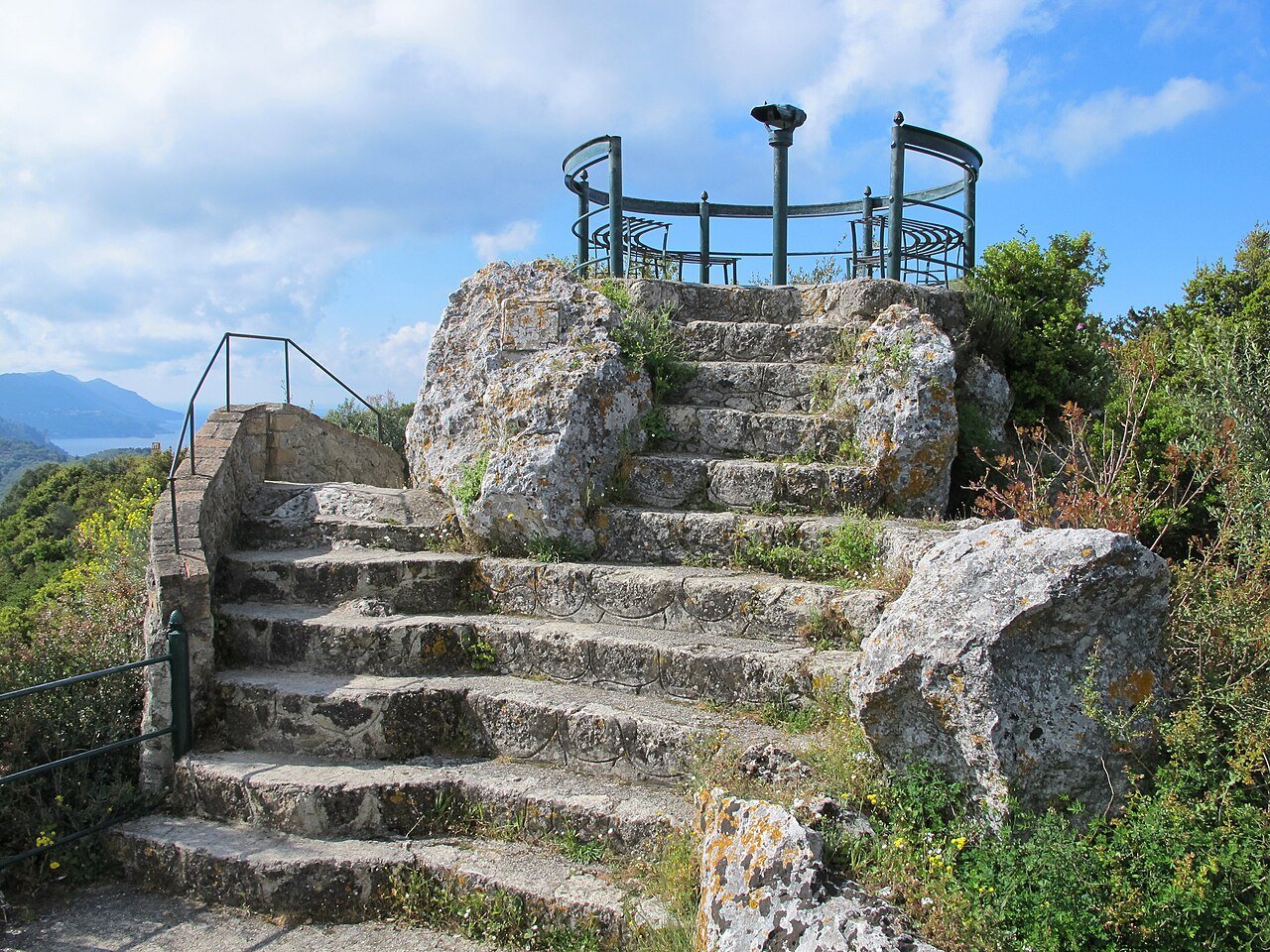
The view explains the choice. From the summit you look west over olive groves to the open Ionian Sea, and on a clear day across a large part of the island in both directions. Today a short, steep path leads from the upper village to the lookout, where couples fix padlocks to the old iron railings. Go 30 to 45 minutes before sunset to find a good spot, especially in July and August.
Exploring the Village
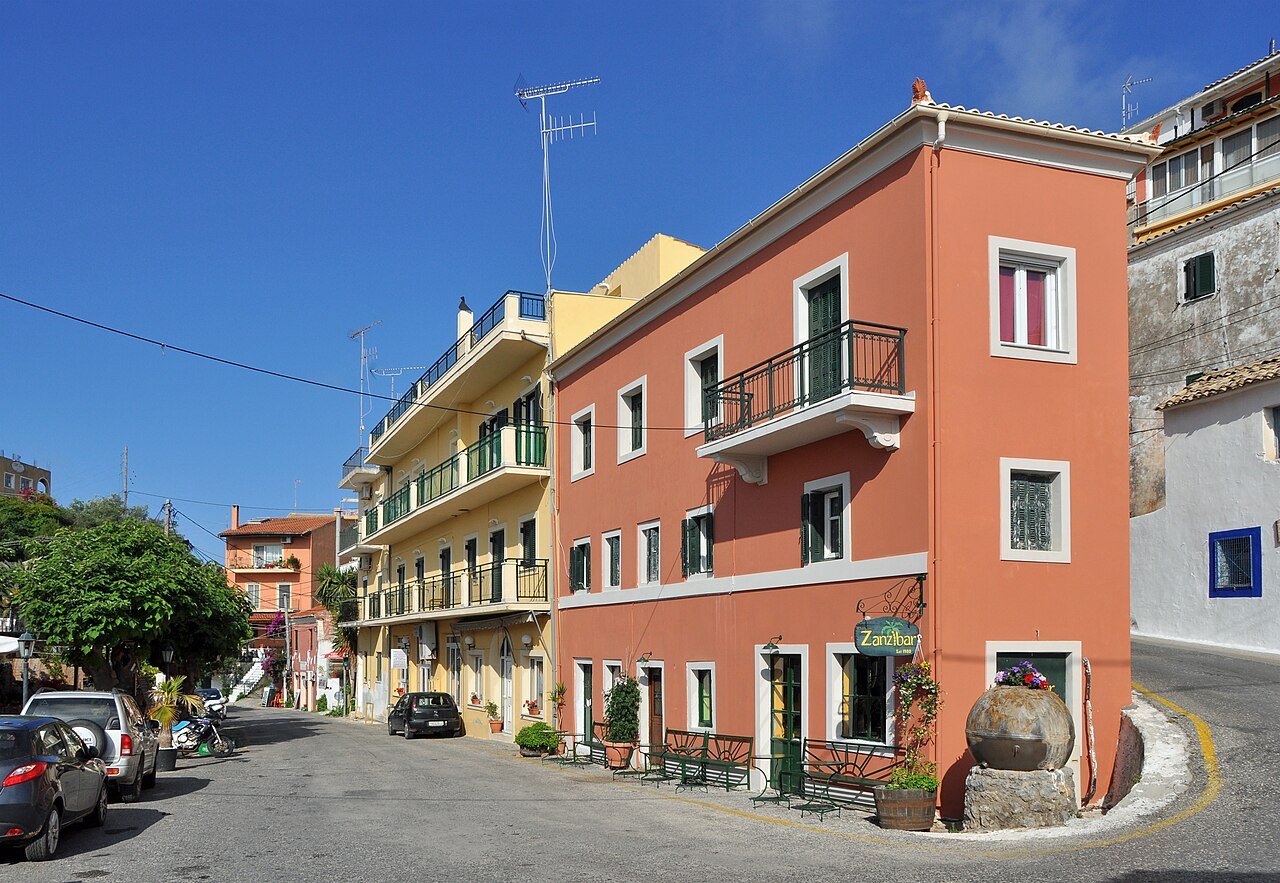
Pelekas is small enough to walk end to end in a few minutes, but it rewards a slower pace. The main lane climbs from the square towards the Kaiser’s Throne, lined with tavernas, cafés and a few shops. Side streets reveal old stone houses, courtyards with bougainvillea and the village churches. In the evening the village fills with people coming up from the beaches for dinner with a view.
- Kaiser’s Throne. The sunset lookout at the highest point of the village, a short uphill walk from the centre.
- The village churches. Six churches recorded by 1755 are still in use, giving Pelekas one of the densest groups of old churches in central Corfu.
- The main lane and square. The place for an evening walk, dinner and a drink after the beach.
- The Corfu Trail. The island’s long-distance footpath (about 220 km) passes through the area, with good walking on the hills around the village.
- The Ropa Valley. A couple of kilometres north, a flat green plain with Corfu’s golf course and quiet country roads.
Beaches Near Pelekas
The beaches are why most people come to the Pelekas area in summer. Kontogialos sits right below the village and was a gathering place for free-spirited travellers in the 1960s. Glyfada, a little further north, is one of the most popular beaches on the island. Myrtiotissa, below the Monastery of Panagia Myrtiotissa, is the one with the reputation: Lawrence Durrell praised it as perhaps the loveliest beach in the world, and it remains wild because of the steep access. The distances below are by road and approximate.
| Beach | Approx. distance from village | Character | Best for |
|---|---|---|---|
| Kontogialos (Pelekas Beach) | About 1 to 2 km downhill | Long sandy bay with sunbeds, tavernas and parking | Families, easy access |
| Glyfada | About 4 to 5 km by road | Wide golden sand, fully organised, one of Corfu’s most popular | Facilities, water sports |
| Myrtiotissa | About 4 km, last stretch steep on foot | Small, wild, below a monastery, no big development | Natural scenery, quiet swims |
| Yaliskari | About 3 km | Small cove south of Kontogialos | Fewer crowds |
| Ermones | About 6 km | Pebbly bay with a small resort | Combining with Ropa Valley |
How to Get to Pelekas
By car, follow the signs from Corfu Town towards Alepou and Pelekas; the drive takes about 25 to 30 minutes. Parking in the centre is limited in high season, so arrive early for the sunset or use the parking areas on the edge of the village. By bus, Blue Bus No. 11 runs from San Rocco Square in Corfu Town with around ten departures a day in season, fewer on Sundays. Buy your ticket before boarding at the kiosk in the square or from shops in Pelekas, and check the current timetable, which changes by season.
Best Time to Visit and Practical Tips
May, June and September are the sweet spot: warm sea, long evenings and fewer crowds at the Kaiser’s Throne. July and August are lively, with full beaches and busy tavernas, so book dinner if you want a terrace table at sunset. In winter the village is quiet and many beach businesses close, but the view and the walks are just as good.
- Time your visit for sunset and plan dinner in the village straight after.
- Wear comfortable shoes; the path to the Kaiser’s Throne is short but steep.
- If you go to Myrtiotissa, bring water and be ready for a steep climb back.
- Combine Pelekas with the Achilleion Palace to follow the Kaiser’s route across the island.
- In high season, take the bus or a taxi in the evening to avoid parking stress.
Is Pelekas Worth Visiting?
Yes, and the reason is balance. Many Corfu villages are either authentic but far from the sea, or close to the sea but built for tourism. Pelekas sits between the two: a real village with old churches, a documented history and year-round residents, a few minutes above some of the best beaches on the west coast, with the most famous sunset on the island as its centrepiece. The trade-off is summer crowding in the evening. If you want silence, come in spring or autumn, or visit the viewpoint in the morning.
Pelekas FAQ
What is Pelekas in Corfu famous for?
Pelekas is famous for the Kaiser’s Throne, a hilltop viewpoint where Kaiser Wilhelm II watched the sunset, and for the beaches below it: Kontogialos, Glyfada and Myrtiotissa.
Why is it called the Kaiser's Throne?
Kaiser Wilhelm II owned the Achilleion Palace from 1907 and, until the First World War, regularly came to the rock above Pelekas to watch the sunset. The lookout has carried his name ever since.
How far is Pelekas from Corfu Town?
About 13 km, a drive of roughly 25 to 30 minutes. Blue Bus No. 11 connects the village with San Rocco Square in Corfu Town.
Is there a beach in Pelekas?
Yes. Kontogialos, also called Pelekas Beach, lies just below the village. Glyfada, Myrtiotissa and Yaliskari are all a short drive away.
Can you walk from Pelekas to the beach?
You can walk down to Kontogialos, but the road is steep, so most people take the car, bus or a taxi back up.
What time is sunset at the Kaiser's Throne?
It changes through the year, from roughly 20:45 in late June to roughly 17:30 in late November (Greek local time). Check a sunset app on the day. Arrive 30 to 45 minutes early in summer.
How many people live in Pelekas?
The 2021 census recorded 373 residents in the village and 647 in the wider community, which includes Glyfada and several smaller settlements.
Is Pelekas a good place to stay?
Yes, if you want a village base close to west coast beaches, with tavernas and evening life within walking distance. A car or scooter makes exploring easier.
When is the best time to visit Pelekas?
May, June and September offer warm weather, a swimmable sea and fewer crowds. July and August are the busiest months.
Sources: Wikipedia (Pelekas, 2021 census), pelekas.com village history and bus information, Greek travel guides. Photos via Wikimedia Commons under free licences; authors credited on each file page. Bus times and beach facilities change by season; confirm locally.