
Lakones
- Corfu Villages
-
Oct 28
-
9 min read
- Share post
Northwest Corfu · Villages & Viewpoints
Lakones, Corfu: Village Guide, Bella Vista Viewpoint and History
The village above Paleokastritsa: Spartan roots, the famous view, Angelokastro and the best walks.
Lakones (Greek: Λάκωνες) is a hillside village in northwest Corfu, built on the slopes above Paleokastritsa, about 24 km from Corfu Town. It is famous for the Bella Vista viewpoint, where the road out of the village opens onto one of the most photographed panoramas in Greece: the green coves of Paleokastritsa, the monastery on its headland and the open Ionian Sea.
Most visitors stop for ten minutes, take a photo and drive on to Angelokastro. That is a mistake. Lakones is one of the oldest villages on the island, with written records going back to the 14th century, a founding story rooted in the Peloponnese and a village centre that still feels lived in. This guide explains its history, what to see, how the village relates to Paleokastritsa and Angelokastro, and how to plan a visit worth more than a photo stop.
Lakones at a Glance
| Fact | Details |
|---|---|
| Name | Lakones (Λάκωνες) |
| Location | Northwest Corfu, on the hills directly above Paleokastritsa |
| Altitude | Roughly 180 to 270 m (sources differ; the village climbs a slope) |
| Distance from Corfu Town | About 24 km |
| First written record | 1387 |
| Population | Around 380 residents |
| Architecture | Stone houses mostly from the 18th and 19th centuries |
| Best known for | Bella Vista viewpoint over Paleokastritsa |
| Nearest castle | Angelokastro, about 3.5 km away |
A Short History of Lakones
Lakones is among the oldest villages on Corfu, with the first written reference dated to 1387. Its name points to its founders: settlers from Lakonia, the region of Sparta in the southern Peloponnese. Local tradition tells the story in two versions. In one, members of the Michalas family left Oitylo in the Mani after a feud and settled here. In the other, a group of Lakedaimonians sailing for southern Italy were driven onto Corfu by a storm.
Both versions agree on what happened next. The newcomers first lived near the coast, around today’s Paleokastritsa, and then moved uphill to escape pirate raids. That move is the key to understanding Lakones. Like Old Perithia and Afionas, it is a village that chose safety over convenience, and the height that protected it then gives it its views now.
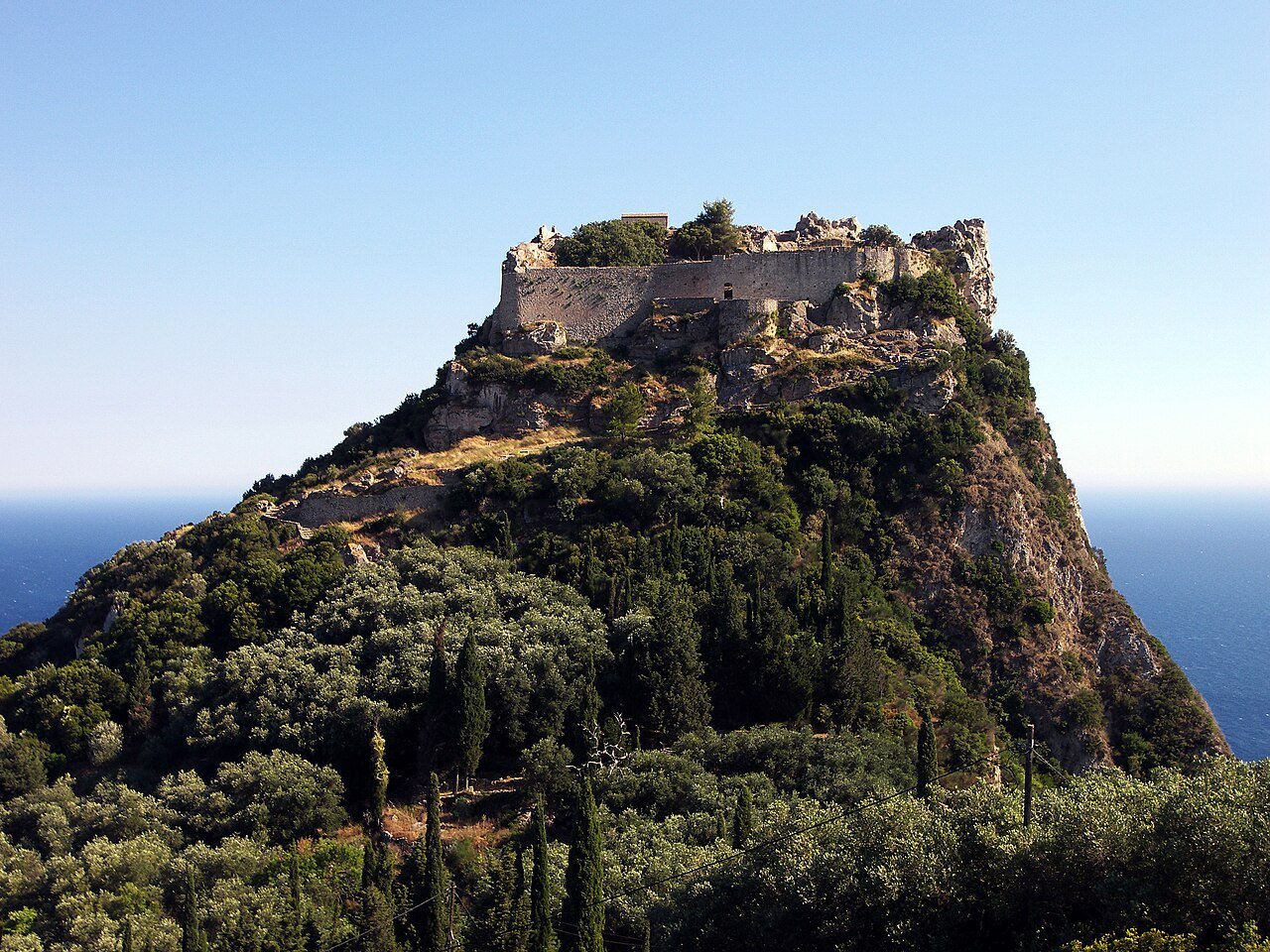
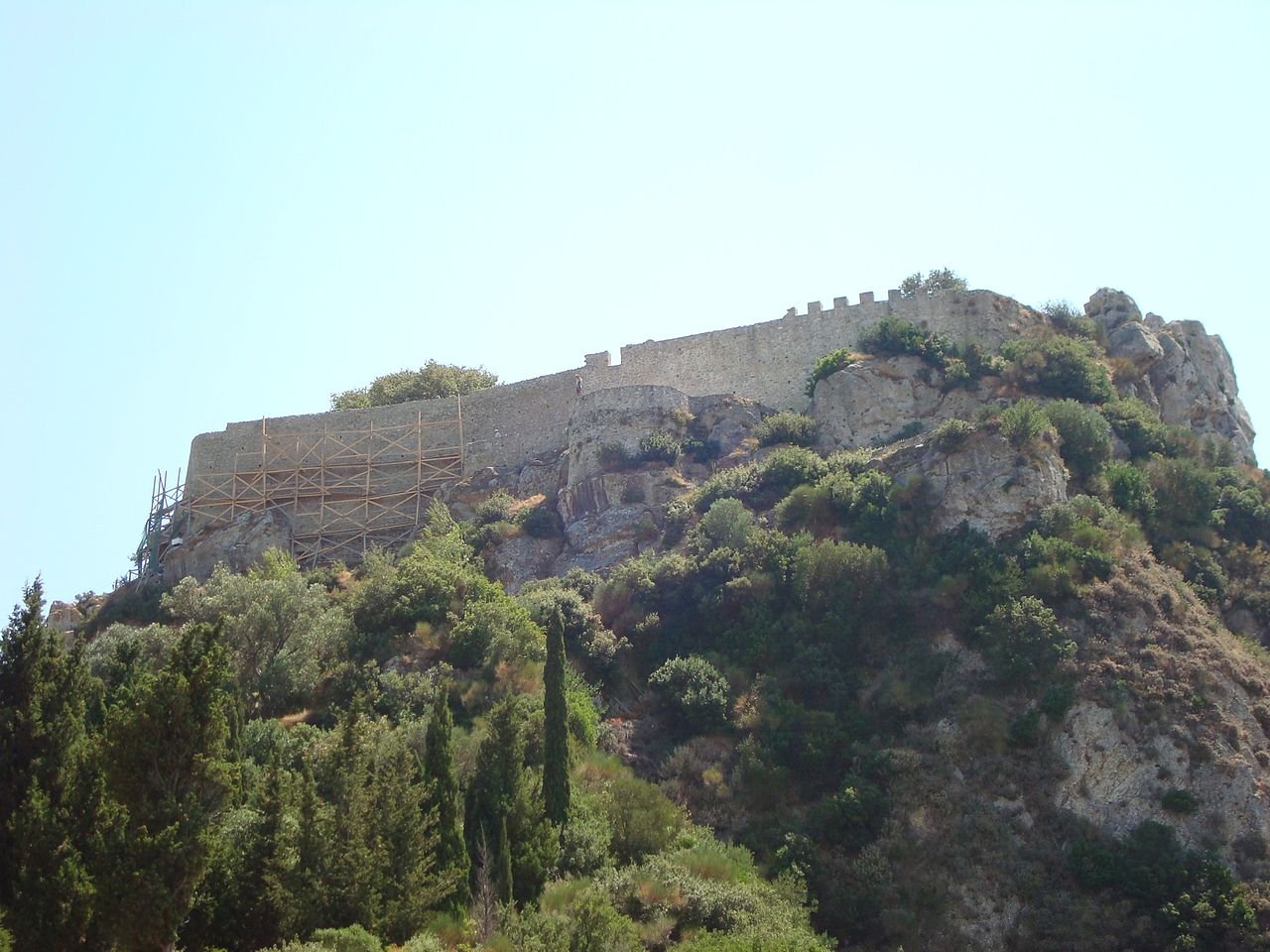
The protection did not only come from altitude. A few kilometres away stands Angelokastro, the Byzantine fortress on a 305 m cliff above the sea. It withstood a Genoese siege in 1403 and Ottoman attacks in 1537 and 1571, and each time thousands of villagers from the surrounding area sheltered inside its walls. For the people of Lakones, the castle was the last line of defence.
Exploring the Village
The heart of Lakones is a small square shaded by a plane tree, with a traditional coffee shop where locals still gather. Around it, narrow lanes lead past 18th and 19th century stone houses, courtyards and churches. The village also has a small folklore museum housed in the building of the Lakonites, the local music group, a sign of how strongly community life has survived here. Lawrence Durrell, in his Corfu book Prospero’s Cell, singled out the dark red wine of Lakones for praise, and the terraced hills around the village still carry vines and olive groves.
- Bella Vista viewpoint. On the road from Lakones towards Angelokastro, with cafés on terraces overlooking the coves of Paleokastritsa.
- The village square. Plane tree, old coffee shop and the best place to see daily village life.
- The stone lanes. 18th and 19th century houses with arched doorways, courtyards and small churches.
- The folklore museum. A small collection in the building of the Lakonites music group.
- Angelokastro. The Byzantine castle a short drive away, with views over the whole northwest coast.
- The footpath to Paleokastritsa. The old route linking the village with the coast below.
Lakones, Paleokastritsa and Angelokastro
Lakones and Paleokastritsa are two halves of the same story. Paleokastritsa is where the founders first lived and where today’s visitors swim, take boats to the sea caves and visit the monastery on the headland. Lakones is the safe place above it, the village the coast population retreated to when the sea became dangerous. Seeing both on the same day, ideally with the castle in between, gives a far clearer picture of how northwest Corfu worked for centuries than any single stop.

| Place | Approx. distance from Lakones | Why go |
|---|---|---|
| Bella Vista viewpoint | On the edge of the village | The classic view over Paleokastritsa |
| Angelokastro | About 3.5 km | Byzantine castle on a 305 m cliff, never captured |
| Paleokastritsa beaches | About 4 km by road | Coves, boat trips to sea caves, swimming |
| Paleokastritsa Monastery | About 5 km | Monastery of the Virgin Mary on the headland |
| Corfu Town | About 24 km | Old Town, fortresses, Liston |
| Corfu Airport | About 25 km | Easy for first or last day visits |
How to Get to Lakones
Drive from Corfu Town towards Paleokastritsa and take the signed road that climbs to Lakones. The road is narrow and steep, with hairpin bends, so take it slowly. Through the village itself the main street runs one way at a time, controlled by traffic lights at each end, so expect to wait a few minutes in summer. Park where signs allow and walk the centre. Buses run regularly between Corfu Town and Paleokastritsa; from there the climb up is best done by taxi or on foot along the old path, which is steep but rewarding.
Hiking Around Lakones
Walkers have several options. The old footpath links Lakones with the coast at Paleokastritsa, and longer marked loops connect Paleokastritsa, Lakones and Angelokastro. A popular full loop is around 14 km with about 500 m of climbing and takes roughly four and a half hours, so it suits fit hikers. Shorter loops around Angelokastro take under two hours. Start early in summer and carry plenty of water.
Best Time to Visit and Practical Tips
Spring (April to June) and autumn (September and October) are the best seasons for Lakones. The hills are green, the air is clear enough to see far along the coast, and walking to Angelokastro or down to Paleokastritsa is comfortable. In July and August the village is busy from late morning, when tour coaches and rental cars head for the viewpoint, and the one-way traffic system slows things down. Early morning gives the calmest light over the coves and the emptiest roads, while late afternoon is ideal for a coffee at Bella Vista followed by dinner in the village. In winter Lakones is quiet and some cafés close, but the view stays the same and the village feels entirely local.
- Visit Bella Vista in the late afternoon, when the light is softer and the coach groups have gone.
- Combine Lakones with Angelokastro and Paleokastritsa for a classic half-day route.
- Check Angelokastro opening days and hours before you go, as they vary through the year.
- Wear good shoes if you plan to use the footpath down to the coast.
- Have a coffee in the square, not only at the viewpoint, to see the real village.
Is Lakones Worth Visiting?
Yes, if you give it more than ten minutes. The Bella Vista panorama alone justifies the drive, but the value of Lakones lies in the combination: a genuinely old village with a documented history since 1387, a founding legend tied to Sparta, a living square and some of the best walking on the west coast, all within a few kilometres of Paleokastritsa and Angelokastro. The trade-offs are the narrow road and summer traffic at the viewpoint. Come in spring or autumn, or late in the day, and Lakones shows its best side.
Lakones FAQ
Where is Lakones in Corfu?
Lakones is in northwest Corfu, on the hills directly above Paleokastritsa, about 24 km from Corfu Town.
What is Lakones famous for?
It is best known for the Bella Vista viewpoint, which looks over the coves of Paleokastritsa, the monastery and the Ionian Sea. It is also one of the oldest villages on the island.
How old is Lakones?
The first written reference to the village dates from 1387. Its stone houses mostly date from the 18th and 19th centuries.
Why is the village called Lakones?
The name refers to settlers from Lakonia, the region of Sparta in the Peloponnese. Local tradition links them to the Michalas family from Oitylo in the Mani or to Lakedaimonians shipwrecked on Corfu.
How do you get from Paleokastritsa to Lakones?
By car or taxi on the steep, winding road (about 4 km), or on foot along the old footpath that connects the coast with the village.
How far is Angelokastro from Lakones?
About 3.5 km. The castle stands on a 305 m cliff and is one of the most important Byzantine fortresses in Greece. Check opening days before you go.
Is the road to Lakones difficult?
It is narrow, steep and has hairpin bends. Inside the village, traffic runs one way at a time with traffic lights, so drive slowly and expect short waits.
Where is the best view in Lakones?
At Bella Vista, on the road from the village towards Angelokastro, where cafés have terraces facing Paleokastritsa.
Can you hike from Lakones?
Yes. Paths connect Lakones with Paleokastritsa and Angelokastro. A full loop of about 14 km with roughly 500 m of climbing takes around four and a half hours.
Sources: Wikipedia (Angelokastro), Greek travel guides and local history sources. Photos via Wikimedia Commons under free licences; authors credited on each file page. Opening hours and traffic arrangements change; confirm locally.