
Doukades
- Corfu Villages
-
Oct 28
-
9 min read
- Share post
Northwest Corfu · Traditional Villages
Doukades, Corfu: History, Theotokis Mansion and the Agios Symeon Walk
A protected traditional village above Paleokastritsa: its square, mansions, history and best walk.
Doukades (Greek: Δουκάδες) is a traditional hill village in northwest Corfu, a few kilometres inland from Paleokastritsa. It is officially protected as a traditional settlement, and it shows: a stone square lined with tavernas, Venetian-style mansions, narrow lanes and olive groves climbing towards limestone cliffs. Behind its quiet appearance lies one of the most interesting stories of any Corfu village, involving a Greek prime minister, an English aristocrat famous across Europe and a medieval battle against Genoese invaders.
Most visitors pass Doukades on the way to the beaches of Paleokastritsa. This guide makes the case for stopping: its history, the Theotokis mansion, the walk to the Agios Symeon viewpoint, where to eat and how to plan a visit.
Doukades at a Glance
| Fact | Details |
|---|---|
| Name | Doukades (Δουκάδες) |
| Location | Northwest Corfu, inland from Paleokastritsa |
| Administration | Municipal unit of Palaiokastritsa, Municipality of Central Corfu and Diapontia Islands |
| First written record | 1616, in a notary document |
| Name origin | From the first settlers, the Doukas family (meaning duke) |
| Protected status | Designated traditional settlement (Law 594/1978) |
| Population (2021 census) | 407 in the village, 487 in the community |
| Best known for | Theotokis mansion, village square tavernas, Agios Symeon viewpoint |
| Distance to Paleokastritsa | About 5 km |
History of Doukades
Like many inland villages in Corfu, Doukades probably grew when coastal communities retreated into the hills to escape pirate raids. The village takes its name from its first settlers, who bore the surname Doukas, and it first appears in writing in a notary document of 1616.
The area’s military history is older still. In 1403, local militia supported by the Venetians fought Genoese invaders near Kratsalo and Kritsilla, close to the village. The fallen were buried at a spot still called Mnimata (the graves), and an inscription at Kritsilla marks the battle. It was the same campaign in which the Genoese besieged nearby Angelokastro for about a year without taking it.
In the 19th century Doukades became the country seat of one of Corfu’s most powerful families, the Theotokis. Their mansion was the home of Georgios Theotokis, four times prime minister of Greece between 1899 and 1909. It was also where Lady Jane Digby, the English aristocrat whose marriages and romances made her one of the most talked-about women of her age, lived after marrying Count Spyridon Theotokis. A cypress she planted on her arrival is said to still stand in the grounds. The village is also linked to the poet and politician Iakovos Polylas and to Ioannis Vaptistis Theotokis, a member of the Filiki Eteria, the secret society behind the Greek War of Independence.
Population: What the Census Shows
| Census year | Village | Community |
|---|---|---|
| 1981 | 491 | Not recorded |
| 1991 | 492 | Not recorded |
| 2001 | 678 | 689 |
| 2011 | 630 | 724 |
| 2021 | 407 | 487 |
The census figures tell an interesting story. Doukades actually grew between 1991 and 2001, unusual for a Corfu hill village, helped by its closeness to the Paleokastritsa resorts and to Corfu Town. Between 2011 and 2021, however, the village lost about a third of its residents. The pattern is typical of the island: tourism supports the village economy in summer, but year-round life increasingly moves to the town and the coast. The protected status helps preserve the buildings; keeping people in them is the harder challenge.
Exploring the Village
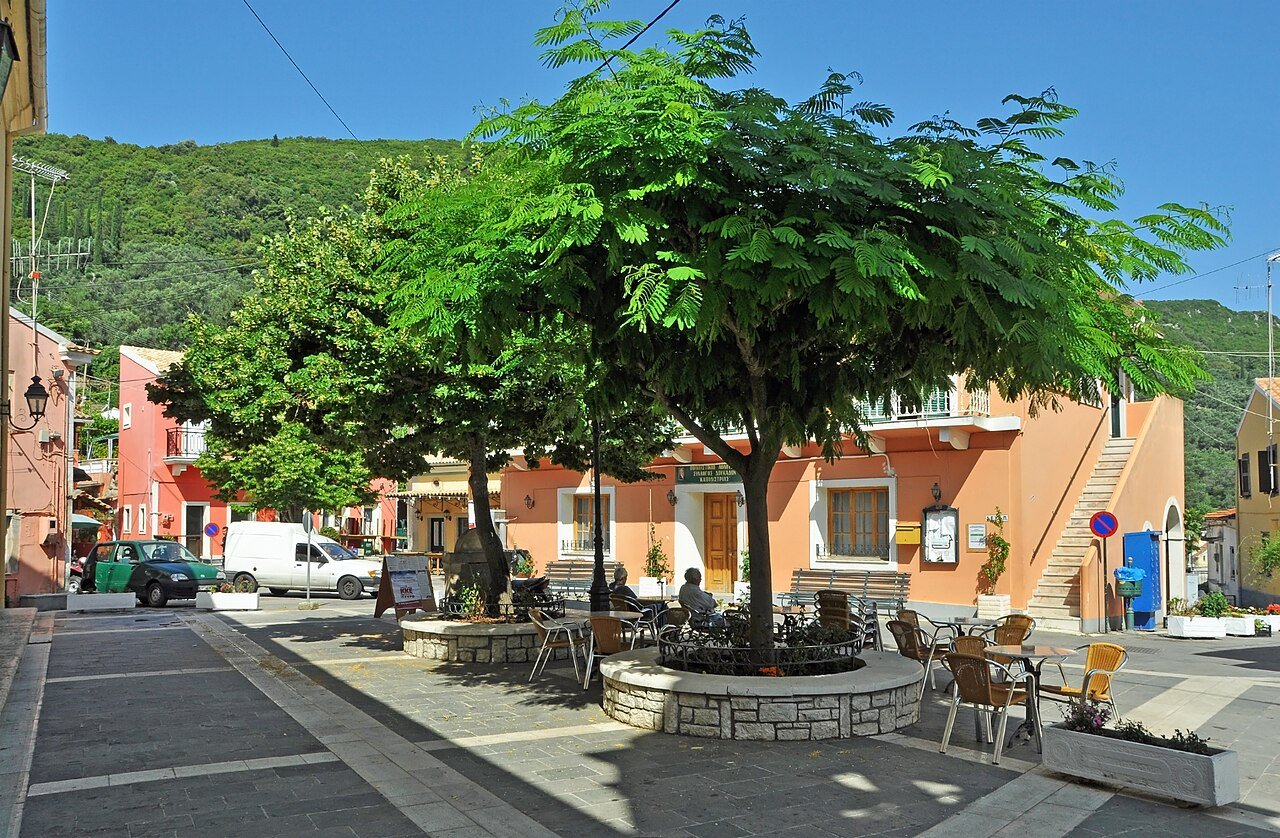
The centre of Doukades is its stone square, one of the most charming on the island, with tavernas and cafés under the trees. One of them, Elizabeth’s, has been serving Corfiot cooking since 1960. This is the place to try local dishes and tsitsibira, the Corfiot ginger beer inherited from the British period. Around the square, lanes lead past Venetian-style houses, the old primary school at the village entrance, the Sagrado of Kouartano and the Koraggios mansion. The church of Panagia Mesochoritissa stands in the middle of the village, its red-domed apse visible from the lanes.
- The Theotokis mansion. A restored stone mansion of about 1,000 square metres, the former country home of the Theotokis family. Its library survived looting in 1946 and 1961 and has been restored.
- The village square. Tavernas, cafés and the best place to feel the rhythm of the village.
- Panagia Mesochoritissa. The central church of Doukades.
- Venetian buildings. The Sagrado of Kouartano, the Koraggios mansion and the old school at the entrance.
- Agios Symeon viewpoint. A chapel on the edge of the cliffs above the village, with sweeping views.
- The 1403 battle site. The Kratsalo area and the inscription at Kritsilla.
The Walk to Agios Symeon Viewpoint
The best reason to stay longer is the walk to Agios Symeon. The path starts about 30 metres from the square along the main street, passes the old church and a Venetian mansion, and climbs through olive groves on a cobbled forest path to a tiny chapel at around 350 metres. From the edge of the cliffs you look over the coves of Paleokastritsa, the bay of Liapades, the Ropa Valley and as far as Corfu Town. Allow about an hour each way and return the same way.
Take care at the top: the cliff edge is not protected, so keep children close. Walkers can also combine Doukades with Angelokastro and Lakones for a longer day in the hills of the northwest.

How to Get to Doukades
Doukades lies just off the main road from Corfu Town to Paleokastritsa, roughly 20 km from town, and is well signposted. The village roads are narrow, so park where signs allow on the edge of the village and walk to the square. Buses on the Paleokastritsa route pass nearby, and the village is also a classic stop for walkers: it is about 5 km on foot from Paleokastritsa, and the Corfu Trail runs through this part of the island.
A simple day plan works well: walk up to Agios Symeon in the cool of the morning, return for lunch in the square, then drive the short distance down to Paleokastritsa for a swim and a boat trip to the sea caves. If you have more time, continue to Lakones for the Bella Vista viewpoint and finish at Angelokastro, the castle that protected these villages for centuries. Nearby Gardelades and Kritsilla are also worth a short detour for walkers who want to see the quieter side of the area.
Best Time to Visit and Practical Tips
Spring and autumn are perfect for the Agios Symeon walk, when the olive groves are green and temperatures comfortable. In summer, walk early and come back for a long lunch in the square, or arrive in the evening when the village fills with locals and visitors from the coast. Some tavernas keep reduced hours outside the season, so check before travelling in winter.
- Start the Agios Symeon walk early in summer and bring water.
- Keep children close at the viewpoint; the cliff edge has no barrier.
- Combine Doukades with Paleokastritsa, Lakones and Angelokastro for a full day in the northwest.
- Try tsitsibira, Corfu’s ginger beer, at one of the square’s tavernas.
- Respect private property around the mansions; several are family homes.
Is Doukades Worth Visiting?
Yes. Doukades offers something the more famous viewpoint villages do not: a complete, protected village with a living square, real historical depth and a walk that delivers one of the finest views in northwest Corfu without crowds. It is the kind of place where you can link a prime minister, Lady Jane Digby and a medieval battle in a single morning, then sit down to lunch. Paired with a swim at Paleokastritsa, it makes one of the best-balanced days on the island.
Doukades FAQ
Where is Doukades in Corfu?
Doukades is in northwest Corfu, just off the road from Corfu Town to Paleokastritsa, about 5 km inland from Paleokastritsa.
Why is the village called Doukades?
The name comes from its first settlers, who had the surname Doukas, a word that means duke. The village is first recorded in a notary document of 1616.
What is the Theotokis mansion?
It is the restored country mansion of the Theotokis family, home of Georgios Theotokis, four times prime minister of Greece between 1899 and 1909. Lady Jane Digby also lived there after marrying Count Spyridon Theotokis.
Who was Lady Jane Digby?
An English aristocrat famous across 19th century Europe for her marriages and romances. She lived in Corfu as the wife of Count Spyridon Theotokis, and a cypress she planted in Doukades is said to still stand.
How long is the walk to Agios Symeon?
About an hour each way on a path that starts near the square and climbs through olive groves to a chapel at around 350 metres, with views over Paleokastritsa and Liapades.
Is Doukades a protected village?
Yes. It is officially designated a traditional settlement under Greek Law 594 of 1978, which protects its architecture.
Where can you eat in Doukades?
There are several tavernas and cafés on the village square. Elizabeth’s, running since 1960, is the best known.
How many people live in Doukades?
The 2021 census recorded 407 people in the village and 487 in the wider community, down from 630 and 724 in 2011.
What happened at Doukades in 1403?
Local militia with Venetian support fought Genoese invaders near Kratsalo and Kritsilla. An inscription at Kritsilla marks the battle and the fallen were buried at Mnimata.
Sources: Wikipedia (Doukades, census 1981 to 2021), local Corfu history guides. Photos via Wikimedia Commons under free licences; authors credited on each file page. Taverna hours change by season; confirm locally.