
Sinarades
- Corfu Villages
-
Oct 28
-
9 min read
- Share post
Central Corfu · Traditional Villages
Sinarades, Corfu: History, Folklore Museum and Aerostato Viewpoint
The village above Agios Gordios: Byzantine roots, Cretan refugees, twelve churches and the best view on the west coast.
Sinarades (Greek: Σιναράδες, also written Synarades) is one of the largest and oldest villages of central Corfu, set on a green hillside about 13 km southwest of Corfu Town, just above the beach of Agios Gordios. It is a protected traditional settlement with twelve churches, a respected folklore museum, a village band founded in 1961 and one of the most dramatic coastal viewpoints on the island, the Aerostato.
What makes Sinarades special is its story of rebirth. Abandoned after its Byzantine beginnings, it was refounded in 1669 by refugees from Crete, and their surnames still fill the village today. This guide explains that history, what to see, why the census numbers matter and how to combine the village with the beaches below.
Sinarades at a Glance
| Fact | Details |
|---|---|
| Name | Sinarades (Σιναράδες), also Synarades |
| Location | West central Corfu, on a hillside above Agios Gordios |
| Distance from Corfu Town | About 13 to 14 km |
| Administration | Largest village of the Parelioi municipal unit |
| Earliest traces | Roman graves nearby; village founded in the middle Byzantine period |
| Refounded | 1669, by refugees from Crete |
| Churches | 12, the oldest from around the late 15th century |
| Population (2021 census) | 646 in the village, 722 in the community |
| Best known for | Folklore Museum, Philharmonic band, Aerostato viewpoint |
History: The Village That Came Back to Life
People have lived around Sinarades for a very long time; Roman graves have been found nearby. The present village dates from the middle Byzantine period, around the 10th or 11th century, and its name appears in records from the 15th century. Its position was chosen with care. Although it lies close to the sea, Sinarades is tucked into the folds of the hills and cannot be seen from the water, which protected it from pirate raids.
The early village did not last. It was abandoned and lay largely empty until 1669, the year the Venetian city of Candia (today’s Heraklion) fell to the Ottomans after a siege of more than twenty years. Refugees from Crete crossed the Venetian-ruled Ionian Sea and many settled here. That is why so many families in Sinarades carry Cretan surnames ending in -akis, such as Vasilakis and Doukakis, more than three and a half centuries later.
The origin of the name is debated. The most common explanation links it to a Byzantine noble family called Synaras. Another theory connects it to axinarades, from the axes used by farmers to clear the land.
Population: What the Census Shows
| Census year | Village | Community |
|---|---|---|
| 1981 | 1,019 | Not recorded |
| 1991 | 1,062 | Not recorded |
| 2001 | 1,124 | 1,218 |
| 2011 | 854 | 920 |
| 2021 | 646 | 722 |
The numbers show a sharp turn. Sinarades grew steadily until 2001, when it passed 1,100 residents, then lost more than 40 percent of its population in twenty years. Part of the reason is the pull of Corfu Town and the coast, and part is the wider demographic decline of the Greek countryside. The village still has strong institutions, including the Philharmonic, a youth and cultural centre and the museum, and these are exactly what keep a community together as it shrinks.
Exploring the Village
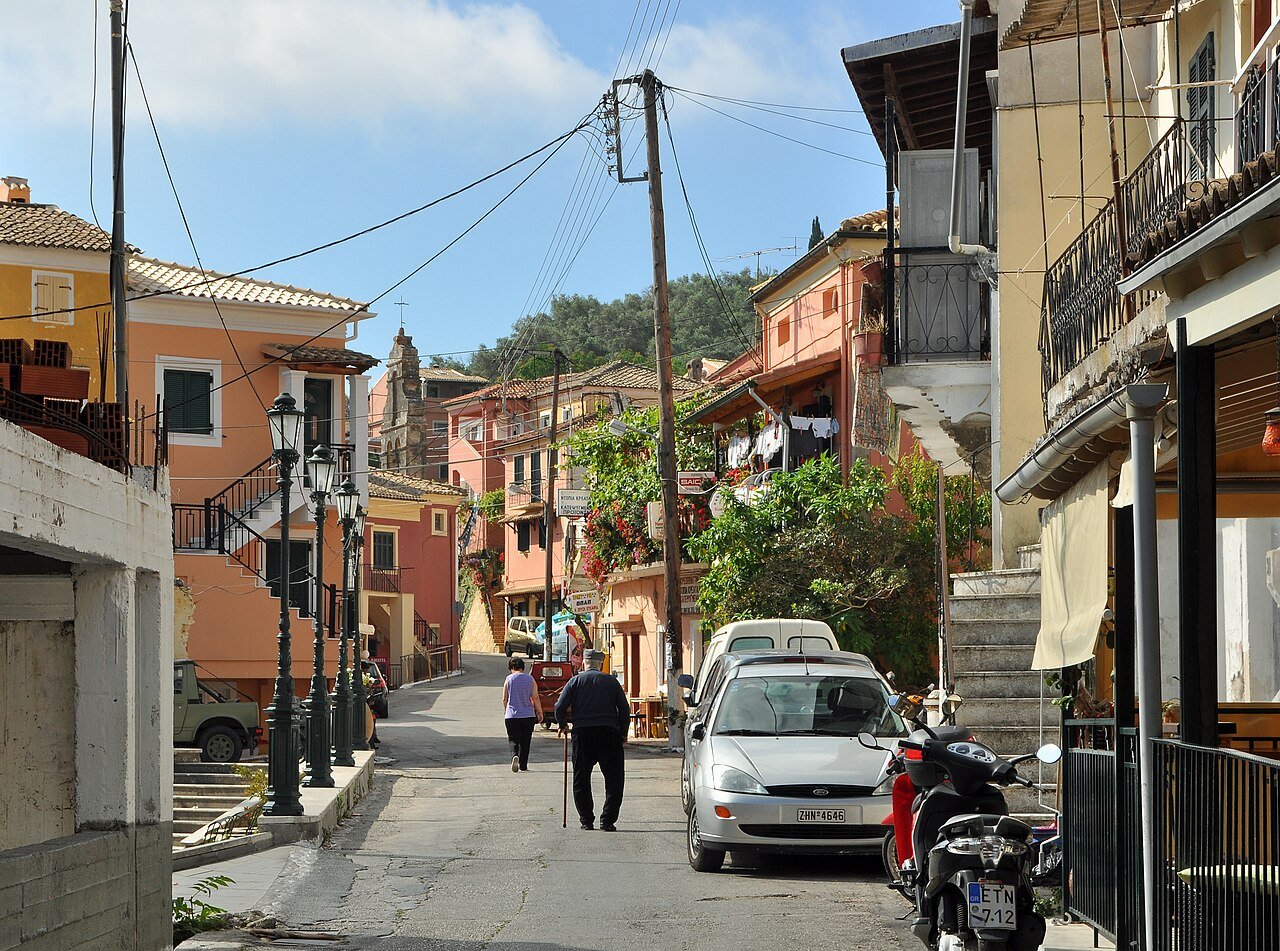
Sinarades is often described as an open-air museum. The houses stand close together along stone stairways and lanes, built in a defensive style with vaulted ground-floor rooms known as volta, arched entrances and thick walls. Facades painted ochre, pink, orange and green mix with bare stone and wooden balconies. The small central square has two cafés and a taverna that stay open all year, and it is the natural place to park and start walking.
Of the twelve churches, the most important is the three-aisled basilica of Agios Nikolaos and Agios Spyridon near the square. Its renovation in 1990 revealed a stone iconostasis, and it houses a church organ said to have come from Italy, a rare feature in an Orthodox church. Music runs deep here: the Sinarades Philharmonic, founded in 1961 with 15 members, now has more than 75 and plays at major island events, including the Palm Sunday and 11 August processions of Saint Spyridon in Corfu Town.
- Folklore Museum of Central Corfu. A two-storey village house showing how families lived between about 1860 and 1960.
- Agios Nikolaos and Agios Spyridon. The main church, with its stone iconostasis and Italian organ.
- The old lanes. Vaulted volta rooms, arched doorways and colourful facades.
- Aerostato viewpoint. A cliff-top lookout in the Aspes area with a balloon’s-eye view of the coast.
- Kyra Dikia islet. A tiny island with a chapel below the viewpoint, linked to the legend of the stones of the bride.
- Agios Gordios and Yaliskari. Beaches just below the village.
The Folklore Museum of Central Corfu
The Folklore Museum is the best introduction to rural life in central Corfu. It was created through the work of local teacher and folklorist Nikos Paktitis and the Historical and Folklore Society of Middle Corfu, and has occupied a traditional two-storey house since the 1980s. The ground floor is arranged as a typical village home, with porch, kitchen, dining room, hall and bedroom furnished with period objects. Upstairs are costumes, musical instruments, farm tools, a cobbler’s workshop, ceramics and fishing equipment. The star exhibit is a section of a raft made from cane and fennel stalks, used by fishermen on the west coast until the 1950s. The museum usually opens in the mornings from May to October; check current days and hours before visiting.
Aerostato Viewpoint and the Beaches Below
A short drive from the village towards Aspes, the Aerostato viewpoint looks down sheer cliffs onto the bay of Agios Gordios and the islet of Kyra Dikia. Local legend says two rocks off the islet are a bride and her companion, turned to stone after pirates tried to carry her off. The chapel on the islet opens only on a couple of feast days a year. Below the village, a pine forest runs down to the smaller beaches of the area, while Agios Gordios offers a long sandy bay with full facilities.

How to Get to Sinarades
From Corfu Town follow the signs southwest towards Agios Gordios; Sinarades is on the way, about 20 minutes by car. Park in or near the central square and explore on foot. Local buses link Corfu Town with Agios Gordios via the village, but check the seasonal timetable.
Best Time to Visit and Practical Tips
May, June and September are the best months: the museum is open, the sea at Agios Gordios is warm and the village lanes are pleasant to walk. July and August bring busy beaches below, but Sinarades itself stays calm, which makes it a good escape in the hottest hours. If your trip falls around Easter, Palm Sunday or 11 August, look out for the Philharmonic, which marches in the Saint Spyridon processions in Corfu Town. In winter the museum is closed, but the square’s café and taverna stay open and the village shows its everyday, year-round side.
- Visit the museum in the morning, then head down to Agios Gordios for the afternoon.
- Go to Aerostato in the late afternoon for the best light over the bay.
- Check the Philharmonic’s programme; hearing the band in the village is a highlight.
- Respect services and private homes when exploring the churches and lanes.
- Combine Sinarades with Pelekas and the Kaiser’s Throne, a short drive north.
Is Sinarades Worth Visiting?
Yes. Sinarades rarely appears on postcards, but it is one of the most authentic and culturally alive villages in Corfu. It combines a clear historical story, from Byzantine origins to Cretan refugees, with a museum that explains island life better than most, a strong musical tradition and a spectacular coast just below. For anyone staying near Agios Gordios, it is the obvious and rewarding half-day trip.
Sinarades FAQ
Where is Sinarades in Corfu?
Sinarades is in west central Corfu, about 13 km southwest of Corfu Town, on a hillside directly above Agios Gordios beach.
Why do so many people in Sinarades have Cretan surnames?
After Candia (Heraklion) fell to the Ottomans in 1669, refugees from Crete resettled the village. Their surnames ending in -akis, such as Vasilakis and Doukakis, are still common.
What is the Folklore Museum of Sinarades?
A museum in a traditional two-storey house that recreates village life in central Corfu from about 1860 to 1960, with costumes, tools, instruments and a rare cane and fennel fishing raft.
When is the Sinarades museum open?
It usually opens in the mornings from May to October. Days and hours can change, so call ahead or check its page before visiting.
What is the Aerostato viewpoint?
A cliff-top lookout near Aspes, a short drive from Sinarades, with sweeping views over Agios Gordios Bay and the islet of Kyra Dikia.
How many churches does Sinarades have?
Twelve. The main one, Agios Nikolaos and Agios Spyridon, has a stone iconostasis and a church organ said to come from Italy.
What beaches are near Sinarades?
Agios Gordios lies directly below the village, and smaller beaches such as Yaliskari are nearby.
How many people live in Sinarades?
The 2021 census recorded 646 residents in the village and 722 in the community, down from 1,124 in 2001.
What is the Sinarades Philharmonic?
The village band, founded in 1961 with 15 members. It now has more than 75 and performs at major Corfu events, including the Saint Spyridon processions.
Sources: Wikipedia (Sinarades, census 1981 to 2021), Corfu municipal tourism and local history sources. Photos via Wikimedia Commons under free licences; authors credited on each file page. Museum hours change; confirm locally.